
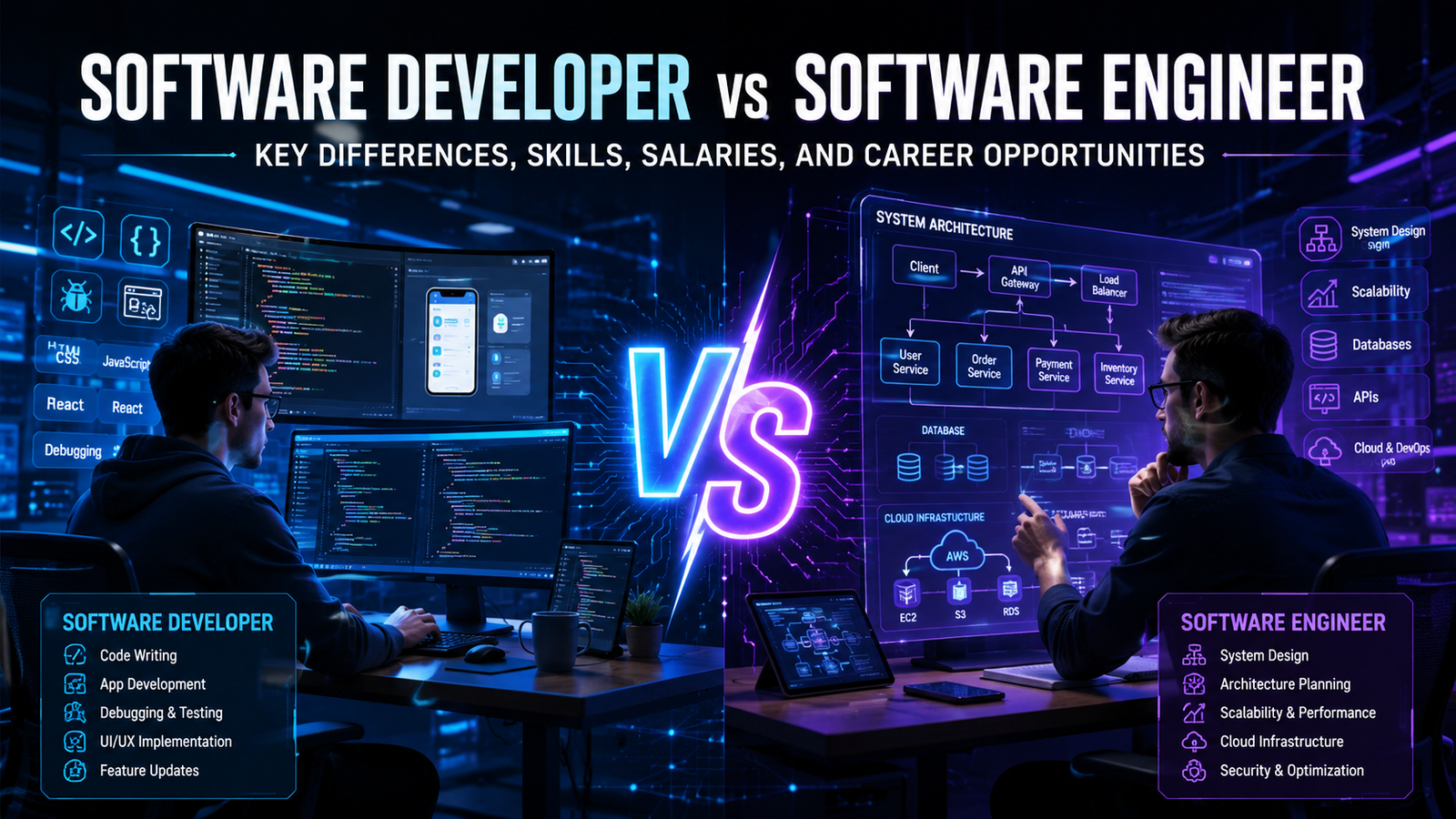
Software Developer vs Software Engineer: Key Differences and Career Opportunities
The technology industry offers many career paths. Software Developer and Software Engineer are two sought-after positions. These titles are often used synonymously. There are however differences between them that are important.
Knowing the differences could help you decide what to pursue if you’re thinking of a technology career. Employers also have different definitions of these roles depending on the size of their business, industry & project needs.
In this detailed software developer vs software engineer guide, one will delve into the specifics of the two roles. We will be comparing their role, skills needed, salary, career advancement and educational requirements. How to get into and what careers are available for beginners will also be covered.
This guide will help you to make an informed decision if you’re a student, a new graduate, or you’re thinking of a career change.
Understanding Software Development and Software Engineering

Prior to comparing these professions, it’s critical to know the duties that each one involves.
What is a Software Developer?
A software developer concentrates on producing software applications that are designed to address a certain problem. They write, test and bugfix software and enhance user experience.
Software developers typically develop software on:
- Mobile applications
- Web applications
- Desktop software
- Business software
- E-commerce platforms
Their main aim is to develop a working and useful software that will satisfy the needs of the users.
What is Software Engineer?
Software Engineer uses engineering principles to develop software. They involve design of systems, planning of architecture, ensuring long-term performances, and making systems scalable.
Some of the software developers’ areas of work include:
- Large-scale systems
- Enterprise software
- Cloud platforms
- Infrastructure solutions
- Complex software ecosystems
Not only do they code, but they also design the systems and plan projects.
Software Developer vs Software Engineer : A Detailed Comparison
Both the professionals and the code written by them can have different roles.
Software Developer vs Software Engineer Comparison Table
| Feature | Software Developer | Software Engineer |
| Main Focus | Building applications | Designing systems |
| Scope | Individual features | Entire architecture |
| Approach | User-focused | System-focused |
| Project Size | Small to medium | Medium to large |
| Responsibilities | Coding and testing | Engineering and planning |
| Collaboration | Team-based | Cross-functional teams |
| Scalability Focus | Moderate | High |
| System Design | Limited | Extensive |
The debate over software developer and software engineer has a lot to do with the size of the project and organization.
The main responsibilities of software developers
Software developers are essential in building the programs, or software, that people use in their daily life.
Key Duties:
- Writing code
- Testing software
- Fixing bugs
- Improving performance
- Updating features
- Maintaining applications
Example
A programmer that is doing work on an online shopping application might:
- Create product pages.
- Develop checkout functionality.
- Resolve payment system problems.
- Improve mobile responsiveness.
They’re just concerned with making sure that the application works.
A software engineer should have the following responsibilities
Software engineers work on ensuring a system works correctly to enable software applications to function.
Key Duties:
- Designing architecture
- Planning system workflows
- Creating scalable solutions
- Managing infrastructure
- Ensuring security
- Evaluating performance
Example
One of the software engineers in a streaming platform can:
- Design server architecture.
- Plan database structure.
- Improve system reliability.
- Get maximum performance for millions of users.
It is this wider view that is a key component in the discussion of the software developer vs software engineer controversy.
Educational Requirements
Formal education is important for many employers, but it’s also important to have the practical skills.
Degrees Commonly Required:
- Computer Science
- Software Engineering
- Information Technology
- Computer Engineering
- Alternative Learning Paths
There are people who are successful in many professions because they do the following:
- Coding boot camps
- Online certifications
- Self-learning
- Open-source contributions
More attention is now being paid to skills and portfolios than to degree.
Technical Skills Required
Both positions demand very solid technical skills.
Skills Comparison Table
| Skill | Software Developer | Software Engineer |
| Programming | High | High |
| Debugging | High | High |
| System Design | Moderate | Very High |
| Database Knowledge | High | High |
| Cloud Computing | Moderate | High |
| DevOps Knowledge | Moderate | High |
| Testing | High | High |
| Architecture Design | Moderate | Very High |
Important Programming Languages
Common languages include:
- Python
- Java
- JavaScript
- C++
- C
- Go
- PHP
Multilingualism improves the job opportunities.
Soft Skills That Matter
This is not a case of techno-knowledge alone.
Essential Soft Skills:
Communication:It is important that the ideas are conveyed clearly between developer and engineer.
Problem Solving:Every day, technology professionals have to work on solving complex problems.
Teamwork:Projects can be inter-departmental projects.
Adaptability:Technology changes rapidly. It is critical to be a life-long learner.
Time Management:It is very important to adhere to deadlines in software projects.
How Beginners Can Enter the Industry
It can be intimidating to get into a technology career. But there are plenty of opportunities for novices.
The importance of having a solid portfolio:
A presentation of work is a way of showing practical skills.
Include:
- Personal projects
- Web applications
- Mobile apps
- Open-source contributions
- Internships
Internships are beneficial and give an insight to the industry.
Certifications:
Popular certifications include:
- Cloud certifications
- Programming certifications
- Cybersecurity certifications
- Networking
Networking with people could lead to new opportunities.
Entry Level Software Developer Jobs: Getting Started
For many, their first steps into software development involve entry level software developer jobs, which help them get started in their careers.
Typically, will require:
- Writing simple code
- Testing applications
- Fixing minor bugs
- Supporting senior developers
Common first-level courses are:
- Junior Software Developer
- Associate Developer
- Application Developer
- Front-End Developer
- Back-End Developer
Most employers value an attitude of learning over a lot of experience.
Key qualities employers seek in fresh graduates
Employers look for applicants to entry level software developer jobs who possess the following skills:
- Technical Skills
- Candidates should understand:
- Basic programming
- Data structures
- Databases
- Version control systems
Portfolio Quality:Grades sometimes aren’t as important as practical projects.
Communication Skills:Employers prefer candidates who have a good ability to collaborate with others.
Problem-Solving Ability:Logical thinking and coding ability are common areas in which test takers are tested during interviews.
Career Paths for Software Developers
There are various software development specialization tracks available.
Popular Career Tracks
Front-End Development
Cares about user interfaces and user experiences.
Back-End Development
Manages back-end processes and databases.
Full-Stack Development
Multi-skill: Front-End/Back-End.
Mobile Development
Creates Android and iOS applications.
Game Development
Develops games and interactive experience.
It’s common for many professionals to start in what is called an entry level software developer job and then work their way into these fields in the future.
Career Paths for Software Engineers
Frequently, software engineers enter into wider, more technical areas of leadership.
Common Career Progression
- Junior Engineer
- Software Engineer
- Senior Software Engineer
- Lead Engineer
- Engineering Manager
- Technical Architect
This track typically has a progression of roles that will include more responsibility in system design and architecture.
How much do people make in the industry?
Compensation varies by:
- Location
- Experience
- Skills
- Industry
- Company size
Overall, tech jobs tend to pay well for techies.
Salary Comparison Table
| Experience Level | Software Developer | Software Engineer |
| Entry Level | Moderate | Moderate |
| Mid-Level | High | High |
| Senior Level | Very High | Very High |
| Lead Level | High | Extremely High |
| Architect Level | Moderate | Extremely High |
It is crucial to comprehend the salary potential when considering a career path between software developer and software engineer.
Software Developer Programmer Salary Overview
People looking into technology jobs often seek out information on the software developer programmer salary they can anticipate.
There are a number of factors that can impact earnings:
- Technical expertise
- Certifications
- Industry demand
- Geographic location
- Years of experience
In general, the higher the technical capabilities and the more experience a professional has in projects, the higher their salary.
After a few years (usually 3 to 5), the average software developer programmer salary tend to rise considerably.
Factors That Affect Software Salaries
There are a number of factors that may affect the income.
Experience
Generally, those with experience make more money.
Specialized Skills
High-demand skills include:
- Artificial Intelligence
- Machine Learning
- Cloud Computing
- Cybersecurity
- Data Engineering
- Industry
There are some industries that pay more:
- Finance
- Healthcare Technology
- Cloud Services
- Enterprise Software
- Artificial Intelligence
Often, professionals who want to increase their software developer programmer salary options take specialized fields in technical areas.
Career Growth Opportunities in Technology
Technology, as one of the fastest growing industries in the world, continues to grow. With businesses moving towards digitization, the need for experts in the field of development and engineering is on the rise.
A lot of professionals start out in a lower level position, and then they slowly work their way up.
Career Growth and Job Opportunities Table
| Career Stage | Software Developer Path | Software Engineer Path |
| Entry Level | Junior Developer | Junior Software Engineer |
| Early Career | Software Developer | Software Engineer |
| Mid-Level | Senior Developer | Senior Software Engineer |
| Advanced | Lead Developer | Lead Engineer |
| Management | Development Manager | Engineering Manager |
| Executive | Director of Development | Chief Technology Officer (CTO) |
The two paths have good opportunities for progression. The option that is best for you is dependent on your interests and future objectives.
Industry Demand for Developers and Engineers
There’s practically no industry that doesn’t use software these days.
Industries that are in demand for software professionals.
- Healthcare
- Banking
- Education
- E-commerce
- Telecommunications
- Manufacturing
- Entertainment
- Government
Businesses require experts who can create, support and enhance software systems.
This demand has resulted in numerous grads looking for the entry level software developer jobs right after graduation.
So, which role is better for beginners?
It is a common question for many to ask whether they should be a developer or engineer.
- It’s a matter of personal preference.
- If You: Select Software Development
- Enjoy building applications
- Every day you’ll be writing code like you do every day.
- Have a passion for user experiences
- Wisely select software features to work on
If you’re looking for a software engineering program, select one of the following:
- Enjoy system design
- Similar to the approach of solving larger scale problems
- Desire to contribute to the design of buildings. Interested in design of buildings.
- Like to plan and optimize technically
A lot of professionals start their career in software development and then move on to software engineering.
Daily Work Environment
It can be very different for both professionals on a day-to-day basis.
The typical software developer day. The normal day of a Software Developer.
A Developer can expend time:
- Writing code
- Reviewing code
- Testing applications
- Fixing bugs
- Updating features
- Attending team meetings / discussions
- Typical Day of a Software Engineer
A software engineer could work for:
- Designing systems
- Reviewing architecture
- Planning infrastructure
- Conducting technical evaluations
- Working in teams with several groups
- Monitoring system performance
This will help you get a better idea of software developer vs software engineer for those who wish to become software developers.
Tools Commonly Used by Developers and Engineers
In this digital era, there are numerous tools that are used by modern software professionals to boost their productivity.
- Development Tools
- Visual Studio Code
- IntelliJ IDEA
- Eclipse
- PyCharm
- Version Control Tools
- Git
- GitHub
- GitLab
- Bitbucket
- Cloud Platforms
- Amazon Web Services (AWS)
- Microsoft Azure
- Google Cloud Platform
- Collaboration Tools
- Jira
- Slack
- Trello
- Microsoft Teams
The learning of these tools can enhance employability and career development.
Real-World Example: Building an E-Commerce Platform
Imagine the creation of a big e-commerce website.
Software Developer Responsibilities
The developer may:
- Create product pages
- Build search functionality
- Design shopping carts
- Implement payment systems
Software Engineer Responsibilities
The engineer may:
- Design server architecture
- Create database structures
- Plan system scalability
- Ensure platform reliability
The example is definitely an illustration of coding features and designing complete systems.
Challenges Faced by Software Developers
All occupations have challenges to overcome.
Common Developer Challenges
Changing Requirements:Requirements for projects are often changed by clients.
Bug Fixing:When there is trouble with the software, it needs to be thoroughly investigated.
Tight Deadlines:There is a tight schedule at work with projects.
Technology Updates:Continuous new tools and frameworks must be learned by developers.
Even with all the aforementioned problems, software development seems to be a rewarding profession for many.
Challenges Faced by Software Engineers
There are unique challenges for software engineers.
Common Engineering Challenges
- System Scalability:Systems need to accommodate increasing number of users.
- Security Risks:Ensuring the security of sensitive information is a crucial task.
- Infrastructure Complexity:In large systems, there are numerous components that are interconnected.
- Performance Optimization:When software is under heavy load, engineers need to make sure that it functions properly.
These duties involve more in-depth technical planning.
Future Trends in Software Careers
Technology is ever changing.
- Artificial Intelligence:More and more applications are being used that utilize artificial intelligence.
- Cloud Computing:Businesses still continue to shift applications to the cloud.
- Cybersecurity:Business security will always be a key consideration for businesses around the globe.
- Automation:Industry is increasingly efficient by using automated systems.
- Internet of Things (IoT):New opportunities for Software professionals with connected devices.
People starting out in this field have solid long-term job prospects.
Why Continuous learning is important
Technology is an ever-changing landscape.
Successful professionals regularly:
- Read technical blogs
- Attend workshops
- Complete certifications
- Build personal projects
- Be a part of online forums.
On-going learning helps keep you competitive in the workplace.
This is particularly crucial if one is looking for a more lucrative software developer programmer salary.
Certifications That Can Boost Your Career
Certifications are a sign of commitment and expertise.
- Popular Certifications
- AWS Certified Developer
- Microsoft Azure Developer Associate
- Google Cloud Professional Certifications
- Oracle Java Certifications
- CompTIA Security+
These can enhance resumes and boost prospects in the job market.
Remote Work Opportunities
The Software Industry has been revolutionized by remote work.
Today, there’s a variety of organizations that employ developers and engineers from all over the world.
The advantages of working remotely. The pros of working remotely.
- Flexible schedules
- Reduced commuting
- Global job opportunities
- Better work-life balance
There are plenty of entry level software developer jobs and experienced as well as remote software developer jobs to be found for candidates.
Job prospects for the next 10 years
Software jobs are likely to continue to be in demand, industry professionals say.
Reasons include:
- Growing digital transformation
- Increased cloud adoption
- Expanding AI applications
- Greater cybersecurity needs
- Continued software innovation
These trends offer good employment opportunities for developers and engineers.
The key differences at a glance
Let’s take a look at some of the differences between software developer and software engineer.
Software Developers
- Concentrate on application development
- Build specific features
- Focus on and identify the needs of the user.
- Develop software products directly one-on-one with partner(s)
Software Engineers
- Ensure attention is given to system architecture
- Design scalable solutions
- Take care of greater technical issues
- Consider long-term performance
These differences are important to candidates to make choices about career.
Making the Right Career Choice
Software development might be a better option if you’re interested in making applications and seeing results right away.
In case you are fond of organizing systems and dealing with huge technical issues, software engineering may be a better fit.
There is no one right or one wrong approach. Both are great career opportunities, are well-paying and have a promising future.
If you’re thinking about software developer vs software engineer it’s best to take your own interests into consideration.
Frequently Asked Questions (FAQs)
Is software engineer better than software developer?
Not always. The names of the different roles are different across employers. Software engineers usually have more general software system design and engineering tasks, though.
Can a Software Developer turn to a Software Engineer?
Yes. The workflow of many professionals is to begin as a developer and then progress into engineering roles following some experience and exposure to system design and architecture.
Who receives a higher compensation?
However, in many organizations, software engineers could be paid a little more as they are given a wider range of responsibilities. But, experience and specialization can be more important than job title.
Is coding a skill that is needed for both jobs?
Absolutely. The programming skills of both Software Developer and Software Engineer are crucial.
Do you have enough chances as a beginner?
Yes. There are lots of companies that will offer an entry level software developer job to recent graduates or to those who are aspiring to be software developers.
What affects the software developer programmer salary the most?
Experience, technical skills, certifications, industry, location and specialization are some of the factors.
Is a computer science degree necessary?
While a degree can be useful, many people in the industry learn by doing, self-learning, certifications and boot camps.
Which career has more potential for future growth?
Both career paths have good career development. Engineers can advance to architecture / leadership positions and developers can become specialists / team leaders / managers.
Conclusion
The decision to opt for software development or software engineering is a crucial one to make. Both careers make an important contribution to today’s technology and are integral to the development of digital solutions.
In this article, we examined the difference between software developer and software engineer in various aspects such as their duties, the skills they need to have, their career prospects, their salary packages, and the future possibilities. Software developers are more concerned about building software packages, and engineers more concerned about the design and maintenance of larger systems.
If you’re just starting out, you may find it worthwhile to do an entry level software developer job to gain some experience and build a solid base for a bright future. Experts may find new specializations and opportunities for growth as they accumulate experience.
There is still potential for a good salary in both areas. The technological advancements, cloud computing, cybersecurity, and AI continue to offer avenues for increased software developer programmer salaries in various fields.
The key is to choose the road that’s right for you based on your interests, talents and goals. Regardless of whether you are in software development or software engineering, a lifelong learning and hands-on approach will be essential to successful careers in this exciting and rapidly changing field.