
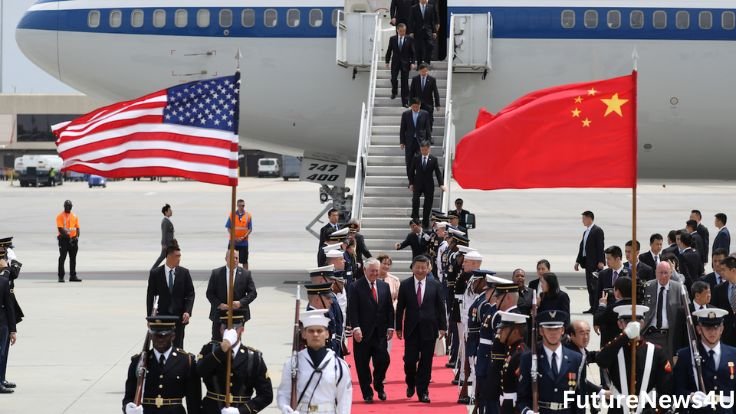
Trump’s Asia Trip 2025: A New Phase in U.S.–China Relations
Trump’s Asia trip revolves around US foreign policy, international trade, and international relations. During Trump’s second presidency, while building trade relations with Asia, especially China, he also focused a lot of his attention on building trade relations with Japan, South Korea, and Malaysia and establishing trade relations with Malaysia was also in his plans.
This situation occurs while the US is trying to amend its foreign policy towards China, especially with the current order of the world being competitive with respect to trade, technology, defence, energy, and geopolitical influence.
Restoration of US Influence in the World
This trip to Asia indicates the US attempts to regain influence in this area of the world. He attended the ASEAN Summit in Malaysia, where regional leaders discussed issues of regional madness, cooperation, and economics. His attendance showed US leadership in this part of the world. As he noted, the US was ready to partner, “on fair and equal terms.”
This statement captures the essence of the visit, with a pointer at improved relations, “America first.”
One of the advantages of Trump’s approach to diplomacy is that it is focused, pragmatic, and centred around American economic interests.
J. Trump’s Vision for American Diplomacy, Trade, and Tariffs
During his trips to Asia, trade issues take the spotlight on the agenda. He keeps saying the U.S. will not stand for unfair trade deals. He justifies his trade policy by placing a new round of 100% tariffs on all Chinese exports to the U.S.
According to him, Trump says the U.S. Trade policies and tariffs are primarily interests of the U.S. and re policies of inequity. The goals of his administration are to safeguard U.S. interests on trade accords in the spheres of manufacturing, technology, and energy.
The belief that tariffs will equate to job growth is something optimistic from Trump. This belief, however, is the complete opposite of the expectations tied to the growing U.S.-China trade war.
Strengthening Regional Ties: Japan, South Korea, and ASEAN
The US Foreign Policy under President Trump included South Korea and China within its scope. South Korea and Japan are Trump’s closest allies within the region, and during this time, there were also talks about trade and military planning. Japan’s closest neighbours, China and Korea, also signed frameworks of a strategy with Japan.
When visiting Seoul to fulfil one of Trump’s promises, South Korea signed joint defence plans. Given the order of regional stability, the proposals in defence of America also included coordinated responses to North Korea’s missile tests.
In the ASEAN summit, Trump’s diplomacy also included the American effort to negotiate peace between recently warring Thailand and Cambodia, who had just signed a ceasefire. In this case, diplomatic American activities that also included Trump focused on peace and conflict resolution during the ASEAN summit.
Symbolic Diplomacy and Soft Power
Due to the politeness culture of Trump’s Asia visit, the reception to him was also strategic. Before receiving him, the preparations included polite songs and dance performances. Trump was also to be received with diplomatic artefacts.
These instances illustrate attempts by the US in recent years to regain interpersonal and cultural ties with some Asian nations that had been neglected. The former President seemed to be looking for some confidence and personal leadership to be shown on the world stage, and this was visible during his public appearances and in the narratives surrounding the media.
Meeting with Xi Jinping: A Critical Moment
During Trump’s presidency, he and Xi Jinping met and interacted personally. These, along with the 2023 APEC, were the most consequential for the extensive discussions based on the inaugural trilateral meetings, which significantly raised enthusiasm toward the in-person meeting.
The initial in-person meetings following the trilateral discussions are anticipated to convey a myriad of prospects regarding the subsequent face-to-face meetings. Trump will stress the necessity of dealing with the US trade deficit and restoring the US’s previous stature in the global order, while Xi will try to calm fears over the weakening and worsening domestic and global economy of China.

The central issues encompass trade and tariffs, the balancing of geopolitical tensions within the region, the technological restrictions China has used against the US, the flow of Russian oil to China, and the South China Sea conflicts. The general expectation is that, no matter what the consequences are, the US-China relations will drive China to focus more on technological issues and climate change, which are critical for the resolution of global economic stagnation.
Global Reactions to Trump’s Asia Trip
In regard to the motives and the consequences the President’s Asian trip was meant to have, there appears to be some agreement in the public domain, whether in the context of criticism or support and particularly so, in the Asian context. Criticising the trip, the Americans point to the lack of goodwill toward the countries as a sign of still severely fractured relations the US holds in the international arena. For the critics of Trump, the visit signalled a new geopolitical shift in focus for the US toward the Asian region, and a reorientation of relations that the US had been holding with the world due to a significant economic imbalance.
Europe and Latin America will suffer the most economic stress in the world order as it shifts and disrupts its economic relations. The downturn in the global economy, and its expectation as a ‘gift’ from Trump to the world, has been followed by his supporters.
There is a division in support for the importance of Trump’s trip to Asia among Asian journalists.
Economic Impacts: Who Gains and Who Loses?
Countering the economic implications of the trip is futile. Due to the new tariffs, the U.S. will likely start paying more for products from China. This will likely cause more Chinese companies to relocate to the U.S. or to countries that are remote from the U.S.
In response, China could issue tariffs of its own or solidify its trade relationship with Russia and India. Then some say a trade conflict, however brief and surgically placed, will cause the global U.S. supply chains to stagnate, downgrading the system. In time, it will recalibrate and regain competitive balance; however, it will take time.
In response to Trump’s statements regarding trade with the U.S. and the meeting with Chinese officials, there is a pessimistic tone that may stem from the fact that Chinese and South Korean trade relations hinge on U.S. imports and, therefore, the stock values are volatile in that regard.
Trump’s Foreign Policy Message: Strength and Self-Reliance
The United States must articulate its position from a place of strength. The United States should not continue to pay for global stability. The costs of self-defence should be shouldered by the Allies as well.
This can also be understood globally along the lines of Trump’s “America First” ideology. From this viewpoint, Trump’s ideology implies that the US is once more, albeit more defined context, a part of the global community.
The ASEAN Summit and Peace Efforts in Asia
During the ASEAN Summit, perhaps the most underrated part of Trump’s trip to Asia was the peace initiatives. No matter if Trump’s priorities were trade-related, his peace advocacy framework between Thailand and Cambodia illustrates a genuine willingness to pursue a commitment toward the peace and stability of the Southeast Asian region.
This strengthens the perception of the US being a responsible global player. A key shift in Trump’s diplomacy is the first sign of a newly evolving relationship with the region, and, more so, the balance of economic and political power that the US has been able to exercise in and over the region seems much less relevant in his administration.
Challenges Ahead
Much of the optimism that surrounded Trump’s tour has already started to be clouded with unresolved issues that, to a significant degree, and in all probability, appear to be truly complicated, if not entirely, unresolvable.
There is an underlying imbalance in US Relations where there is unrequested aggressive militarisation in the South China Sea. There is also a negative atmosphere regarding unresolved issues based on trade, tariffs, and technology. Unresolved issues are still unyielding.
Furthermore, the US’s close allies, these being Japan and South Korea, are also the most diplomatically aligned with the US, and this is most likely to remain the same.
In an attempt to minimise the political overtness in their relationships while improving relations with the US, these countries sought to disengage in confrontations with China. Some critics of the Trump administration have cited uncoordinated diplomacy and unaligned strategies as the basis for the current condition of affairs that have led to the diplomatic criticisms directed at him.
Conclusion
The many parts of diplomacy can be understood in the context of the Trump administration’s trip to Asia. It demonstrated the U.S. economic diplomacy and the economic diplomatic encounters and trade confrontations at the time, while affirming the U.S. position as an overdominant economic partner in the region.
The U.S. diplomacy appears to be in a new constellation having to do with multiple and interlinked trade relationships and the encompassing of the diplomacy and geopolitical power of the continent. Presiding over the meetings with the President and Prime Minister of Taiwan caused a positive domestic reception and projected American might internationally.
The execution of such a design would most likely reconfigure the continent’s position in the world trade and change the international relations constellation. The continent’s uncertainties in global trade and geopolitical relations will probably increase if such a design is not executed.
The value of these interactions historically and contextually speaks to something other than the results, while the discourses within the world order that the U.S. has yet to fully respond t,o and the discourse in the global order that has resulted in a world order that questions the U.S. unipolarity.
Frequently Asked Questions.
What are the objectives of Trump’s 2025 Asia Trip?
Anticipating geopolitical uncertainties in the region, alongside the U.S’s interests and priorities in the region, Trump’s 2025 Asia Trip will likely emphasise the reassessment and reconfiguration of U.S. trade relations with China, the establishment of order in the region, and the consolidation of U.S. geopolitical interests in the region. Trump is expected to revitalise U.S. trilateral relations with Japan and South Korea and U.S. relations with ASEAN.
What Countries Will Trump Visit During His Asia Trip?
In 2025, Trump takes his first trip to Asia, which includes Malaysia, South Korea, and Japan in that order. For the ASEAN Summit meetings, he travelled to Malaysia and then to Japan and South Korea. He is also scheduled to meet with China’s President, Xi Jinping, before returning to Washington.
What Will Trump and Xi Jinping Discuss?
The South China Sea, Xi Jinping’s trade tariffs, Russian oil importation, and the technology exports of the U.S. to China. It is likely to be the most important global diplomacy meeting of the year.
How does this trip fit Trump’s “America First” vision?
The construction of the U.S. economy and “America First” vision simultaneously entails the strengthening of trade agreements, expanding job opportunities, and the sharing of regional security responsibilities. The strengthening of trade agreements and building of jobs to be made reinforces the Trump vision of economic construction of the U.S. and strengthening the global position of the U.S.
What are the possible long-term effects of Trump’s Asia trip?
The strengthening of U.S. relations and the global order of trade will take the longest time to develop. The U.S. will gain and increase influence in the Asia region and in the U.S. economic order of the global economy and trade.
Why did Trump’s Asia trip receive so much global coverage?
Most importantly, the attention owed to the trip is mainly the expected U.S. trade and security policy in the Asia-Pacific, the U.S. and China relations, along with the geopolitical context of the region.