
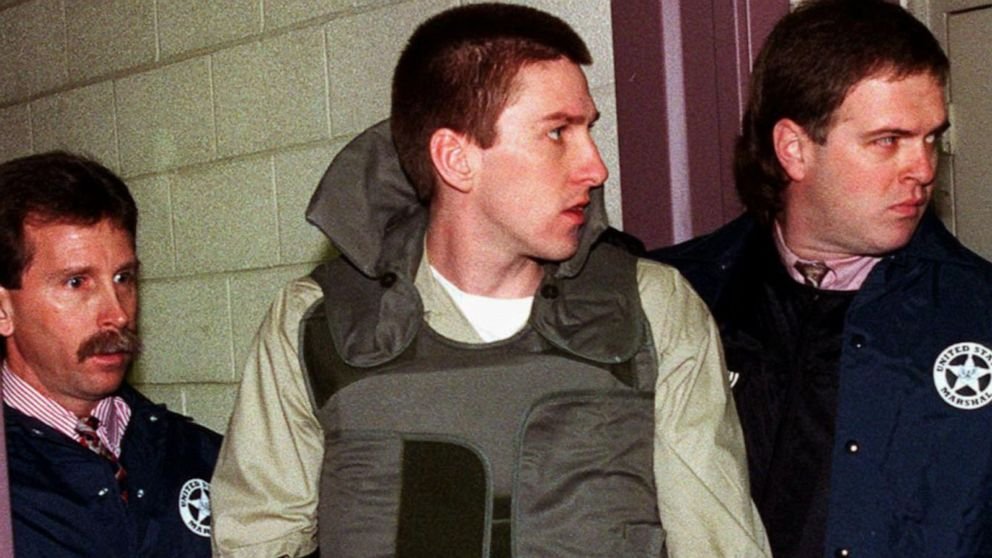
The Making of a Domestic Terrorist: Timothy McVeigh
The events during the Waco Siege at the Branch Davidian compound resulted in the deaths of 76 people which outraged Timothy McVeigh and completely radicalized his thoughts and actions even more. He was compelled to visit and see for himself the standoff between federal agents and David Koresh and his followers. He was interviewed by local media near the standoff and condemned the raid. He saw the federal government overreaching to make arrests and confiscate guns from owners. McVeigh viewed this as an act of war by the government against its citizens. Two years later, McVeigh committed the worst domestic terrorism attack in U.S. history in Oklahoma City.
On February 28, 1993, the Bureau of Alcohol, Tobacco and Firearms (ATF) an agency in the Department of Treasury at the time that would later be transferred to the Department of Justice in 2003 was executing a federal search warrant and arrest warrants at the Branch Davidian compound for weapons violations.
ATF used their specialized tactical team for the enforcement operation; unfortunately, the element of surprise was compromised by a local reporter who knew of the pending raid and asked a U.S. Postal Service carrier directions to the compound who happened to be Koresh’s brother-in-law. He tipped off Koresh who had his followers fully armed and prepared for the ATF raid. During the execution of the search warrant, four ATF Special Agents were shot and killed by Branch Davidians inside the compound. David Koresh and others were also shot and injured during the shootout with the federal agents. Koresh is recorded calling 911quoting scripture to the operator who pleads with them to stop shooting and surrender to the authorities. A cease fire is eventually agreed and ATF removed their injured and dead agents from the scene and retreated from the compound.
As a result, the FBI responded and took control of the scene attempting negotiations with Koresh. The standoff lasted 51 days, resulting with the FBI tanks making an approach on the compound in an effort to force them out. Shortly thereafter, the compound is engulfed in flames resulting in the deaths of 76 Branch Davidians including 25 children and David Koresh. Evidence from listening devices showed that Koresh and his followers started the fire and not the incendiary tear gas canisters used by the FBI.
The tragic deaths at Waco would be one of the main reasons Timothy McVeigh would execute the bombing at the Oklahoma City federal building on April 19, 1995 two years after the deadly siege.
McVeigh wanted locations that housed federal law enforcement agencies like ATF, FBI, DEA, Secret Service, U.S. Marshals and others. In December 1994, McVeigh and Fortier visited the Alfred P. Murrah federal building which was named after a federal judged and had law enforcement agencies inside the building. McVeigh liked the location and planed the attack for April 19, 1995 to coincide with the second anniversary of the Waco siege.
On August 1994, McVeigh obtained nine binary-explosive Kinestiks from Roger Moore, a gun collector. The duo obtained all the material for their home-made explosive device. Later in the year, in a one-month period Terry Nichols purchased hundreds of pounds of ammonium nitrate in McPherson, Kansas. When approached by McVeigh to assist with the operation, Michael Fortier allegedly refused. They even robbed Moore of $60,000 worth of property from his residence to include firearms, gold, silver and jewels. These items would later be recovered in Nichol’s home and storage shed he had rented.
McVeigh later showed a diagram to Fortier and his wife Lori of the planned construction of the explosive device. He planned to have more than 5,000 pounds of ammonium nitrate fertilizer mixed with about 1,200 pounds of liquid nitromethane and 350 pounds of Tovex. The explosive mixture would be contained in sixteen 55-U.S. gallon drums weighing over 7,000 pounds.
Days before the attack, the duo removed the bomb supplies from their storage unit in Herrington, Kansas and loaded everything into the Ryder rental truck and drove to Geary Lake State Park. Once at the park, they nailed boards onto the floor of the truck holding the thirteen barrels in place and mixed the chemicals using plastic buckets and a bathroom scale. McVeigh had a back-up plan in case the primary fuse failed. He would use his Glock, model 21 semi-automatic .45 caliber pistol at close range to ignite the charge. McVeigh added more explosives to the driver’s side of the cargo bay. Allegedly, McVeigh arranged the barrels in the shape of a backwards J to maximize the destructive power of the bomb and added a dual-fuse ignition system accessible from the truck’s front cab. After the completion of the bomb, they parted their separate ways with Nichols returning home to Herrington and McVeigh heading towards Junction City with the explosive barrels in the truck. The bomb making materials had cost over $5,000.
On April 19, 1995, McVeigh decided to destroy the Oklahoma City federal building at 9:00 AM instead of 11 AM. Allegedly, McVeigh carried with him pages from the Turner Diaries, a fictional novel about white supremacists igniting a revolution by blowing up the FBI headquarters at 9:15 AM using a truck bomb. McVeigh also wore a printed T-shirt with the words in Latin, “Sic semper tyrannis” meaning tyrannical leaders will inevitably be overthrown. The same phrase that John Wilkes Booth shouted immediately after assassinating Abraham Lincoln.
McVeigh entered Oklahoma City around 8:50 AM heading towards the Murrah federal building. He parked the Ryder truck in a drop-off zone under the building’s day care center, exited and locked the truck. He had lit both fuses prior to parking the truck near the federal building. He had two minutes to distance himself from the immense blast that was about to occur. At 9:02 AM, the 5,000-pound bomb exploded on the north side of the building killing 168 people and injuring over 600. The blast created a 30-foot wide and 8-foot-deep crater destroying one third of the federal building while also damaging 324 buildings within a 4-block radius. The blast measured 3.0 on the Richter magnitude scale.
Ninety minutes after the attack, McVeigh was stopped by an Oklahoma State Trooper while driving his yellow 1977 Mercury Marquis without a license plate and was arrested for having a concealed firearm. Shortly before his releases from county jail, McVeigh was recognized as the suspect of the Oklahoma City bombing and charged with the heinous act while Terry Nichols surrendered in Herrington, Kansas.
Investigators recovered the axle of the truck from the blast and with the vehicle identification number (VIN) were able to link the Ryder truck to a rental location in Junction City, Kansas. When interviewed by authorities, the owner of the agency was able to describe the appearance of McVeigh who used a sketch to implicate him to the bombing. Another witness remembered McVeigh who had parked a large yellow Ryder truck in the motel parking lot and signed using his real name at the motel the night before the bombing.
At the time, this would be the largest criminal investigation in U.S. history with over 28,000 interviews conducted, 3.5 short tons of evidence seized and one billion pieces of information collected. This was a massive effort by federal, state and local authorities. Later, a change of federal venue was ordered by a district judge from Oklahoma City to Denver, Colorado citing that the defendants would be unable to receive a fair trial.
McVeigh’s federal trial started in late April 1997 and concluded on June 02, 1997 with the jury finding him guilty on eleven counts of murder and conspiracy and sentenced him to death. On June 11, 2001, McVeigh was executed by lethal injection at the Federal Corrections Complex in Terre Haute, Indiana. President George W. Bush approved the execution and it was transmitted on closed-circuit television to the relatives of the victims becoming the first federal execution in 38 years.
Terry Nichols was tried by federal prosecutors and the State of Oklahoma. On the federal case, he was found guilty of conspiring to build a weapon of mass destruction and eight counts of involuntary manslaughter of federal officers and sentenced to life without parole. On the state case, he was found guilty on 161 counts of first-degree murder; however, the jury was deadlocked on sentencing him to death.
Michael Fortier testified against McVeigh and Nichols during their trials and in exchange received a reduced sentence and immunity for his wife Lori who assisted McVeigh in laminating his fake driver’s license that he used to rent the Ryder truck. In 2006, Fortier was released and transferred into the Witness Protection Program.
McVeigh with his limited resources caused mass casualties that sent shock waves around the world. He claimed that the events of Ruby Ridge and Waco was a call to action but failed to understand that the United States is a country of laws. These individuals had violated federal laws and were being held accountable for their criminal actions. McVeigh and others like him are always looking for a trigger to justify their political violence. Even without Ruby Ridge and Waco, he would have found other justifications for his gruesome attacks. He blamed the Clinton administration for violating gun rights, IRS with high taxation, or other events involving federal agents. McVeigh was an angry young man that was manipulated by extremists and never saw their hidden agendas. Timothy McVeigh goes into history as a domestic terrorist, a loner, a radical, a coward and a mass murder who died without his revolution.

Fantastic recollection of such a horrific event in our country’s history.
Thank you for bringing it to light. A tragic loss of so many innocent lives.